
This is the English translation of the German text (done with ChatGPT 3.5).
Somewhat surprisingly, today I’m taking a look at a tool from the world of audio recording. This happens to be my second hobby.
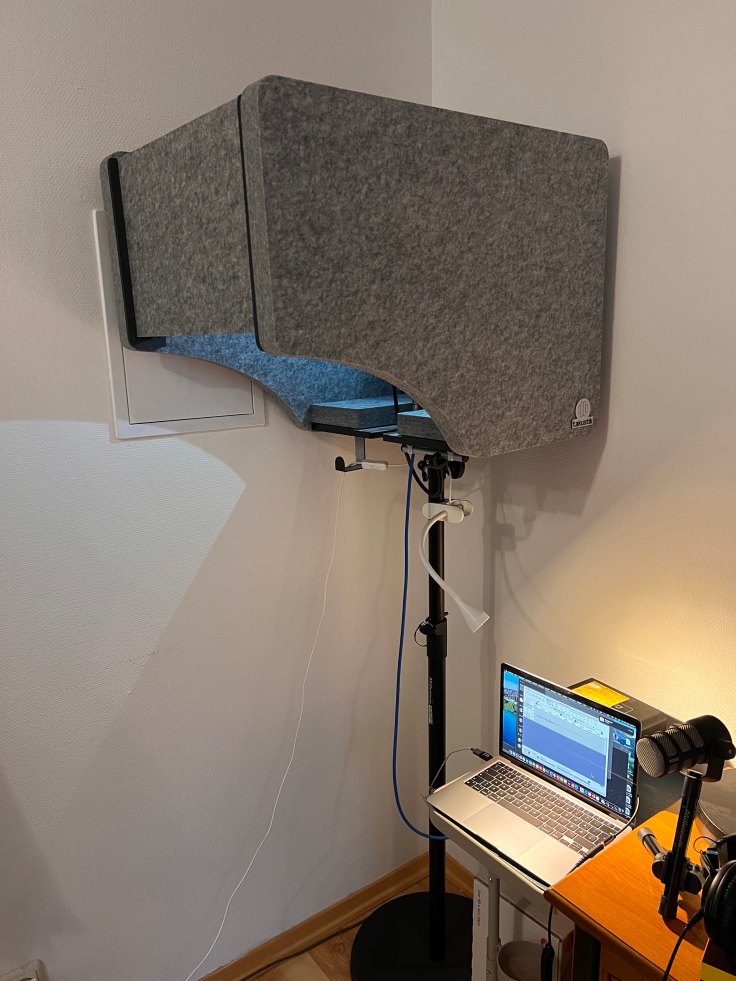
I’m talking about the Vocal Head Booth by t.akustik. T.akustik is the brand from Thomann (Thomann Music Store), one of the largest online retailers for musical instruments and audio equipment, but that’s probably already known.
For a few months now, Thomann has had what they call a Vocal Head Booth in their lineup, which is quite similar to another model, the Isovox 2 (the successor of the Isovox). As far as I know, these are the only two types of these mini vocal booths available on the market.
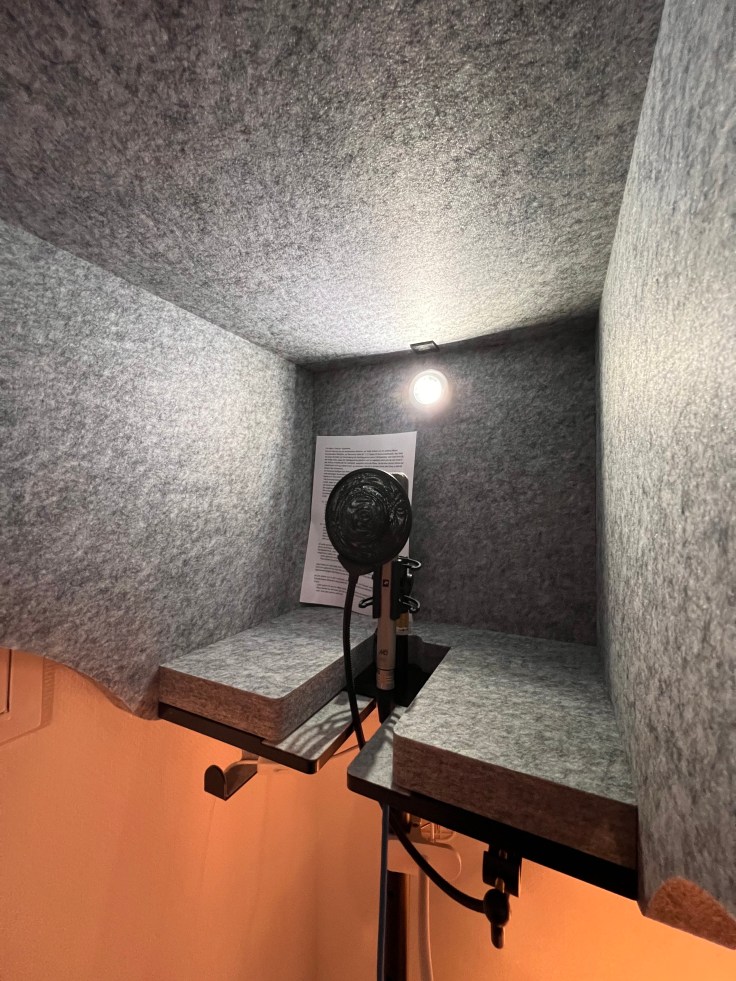
“Mini vocal booth” – what’s that at all? A mini vocal booth is the minimal version of a full-sized vocal booth, logically speaking. Unlike the latter, where a person (the speaker/singer) can fully fit inside, this one only encloses the head up to shoulder height. I’m not a sound engineer, so I can’t make any claims about the implications of the different sizes. However, it’s clear that a vocal head booth isn’t completely sealed; it’s open at the bottom. Why would you need a vocal booth? Because the goal is to try to dampen or keep out the sound of the room in which the booth (whether large or small) is placed. The typical room with its straight, hard walls and, potentially, windows, creates sound reflections that add reverb, or room ambience, to the recording, which is something you want to avoid. This applies to both singing and spoken word recordings.
For those who don’t have enough space for a “real” walk-in vocal booth, the mini version – one that only covers the head, where the voice comes from – can be a solution.
I won’t go into detail about the branded product here (Isovox) since I’m not familiar with it, apart from seeing pictures of it. However, it has the advantage of looking more stylish and being somewhat more portable than Thomann’s equivalent. That’s because the Isovox 2 can be disassembled. Additionally, its side walls can be folded down if a bit of reverb is desired (or if you feel uncomfortable with your head in a small chamber like this box). This is not possible with Thomann’s model. Both of them require a separate stand to be purchased on which they must be placed.
This discussion is solely about Thomann’s Head Booth and its ability to reduce outside sound, specifically in the form of room reflections.
The vocal head booth also has the advantage of dampening sound escaping from it – it’s suppose to prevent annoying your neighbors while (loudly) singing and record songs. However, I haven’t tested this because I don’t sing; I only speak, which has never caused any annoyance in my neighborhood.
My only aim was to find out whether the booth is capable of reducing the room reverb. To make a comparison, I recorded one file with the Head Booth and one without it. Thus, one recording with room reverb and one with reduced room reverb. I used a really good condenser microphone and a very common, affordable dynamic microphone optimized for podcasting.
Thw audio interface I used was the Motu M2 without any pre-amplification of any kind. I left the sound absorbing wall behind the head in place for all tests, so the booth was as closed as possible.
I prepared 4 setups:
1. I used a dynamic microphone, a Røde Podmic. (a) recording inside and (b) outside the head booth.
2. I used a condenser microphone, a Microtech Gefell MT 71 S, both with a cardioid polar pattern. The Gefell has a switch for bass frequency attenuation (a high-pass filter or bass roll-off) to reduce the bass-heavy effect of close-miking. This also has the advantage of reducing muddiness caused by the bass frequencies that the relatively thin walls of the booth do not shield well. There is no Cloudlifter or any other pre-amplifier for the Podmic. (a) recording inside and outside (b) the head booth.
My sole aim is to show how much the Vocal Head Booth filters out room reverb (and any potential background noise).
All sound samples are free of compression or any other software-based processing, except that I adjusted the average volume to a common level since the Podmic is inherently quieter. I cannot comment on what the conversion to mp3 does, but comparability among them should be preserved.
Here are the sound files (in mp3, 128kbit). Please have a listen and judge for yourselves. They are in German language!
It’s clear that the influence of room reverb is already greatly reduced. Whether you like the sound of the Vocal Head Booth in combination with the microphones used is a matter of personal taste.
Condensor microfone (Gefell MT 71 S) outside the headbooth (untreated room):
Condensor microfone (Gefell MT 71 S) inside Vocal Head Booth by t.akustik (still untreated room) :
Dynamic microfone (Røde Podmic) outside the headbooth (untreated room):
Dynamic microfone (Røde Podmic) inside Vocal Head Booth by t.akustik (still untreated room) :



 Nibbinibnibb
Leave a comment