
Today, I would like to introduce a few black inks. The following inks were tested:
- J. Herbin Perle Noire
- Montblanc Black (from 2019) and Mystery Black (2020)
- Pelikan 4001 Brilliant Black
- Cleo Black
- Cross Black
General Approach
This primarily describes the writing properties and appearance on paper, including aspects like shading and ink absorption on the paper (here on a Rhodia pad with 90g/sm). Since shading is generally more visible with broader strokes, I selected the broadest nib I have access to. However, strong shading can also be apparent with a narrow nib, so I also tried the inks with a narrow nib.
For each ink, I used multiple pens (nibs). The writing samples were scanned and left unaltered otherwise. The chromatographies (see below) are presented both unaltered and significantly enhanced in terms of colour (vibrancy) to reveal the ink’s color components (also see the “Color Cast” section).
To demonstrate how the ink behaves on the paper in terms of bleed-through, the reverse side of the writing sample was also scanned. To better assess the location of any bleeding or show-through (if present), the reverse side was mirrored so that you can see which spot on the top side (writing sample) corresponds to the bottom side of the paper. A green marker further assists with this.
Since a picture tells more than thousand words, see the pictures below.
Shading
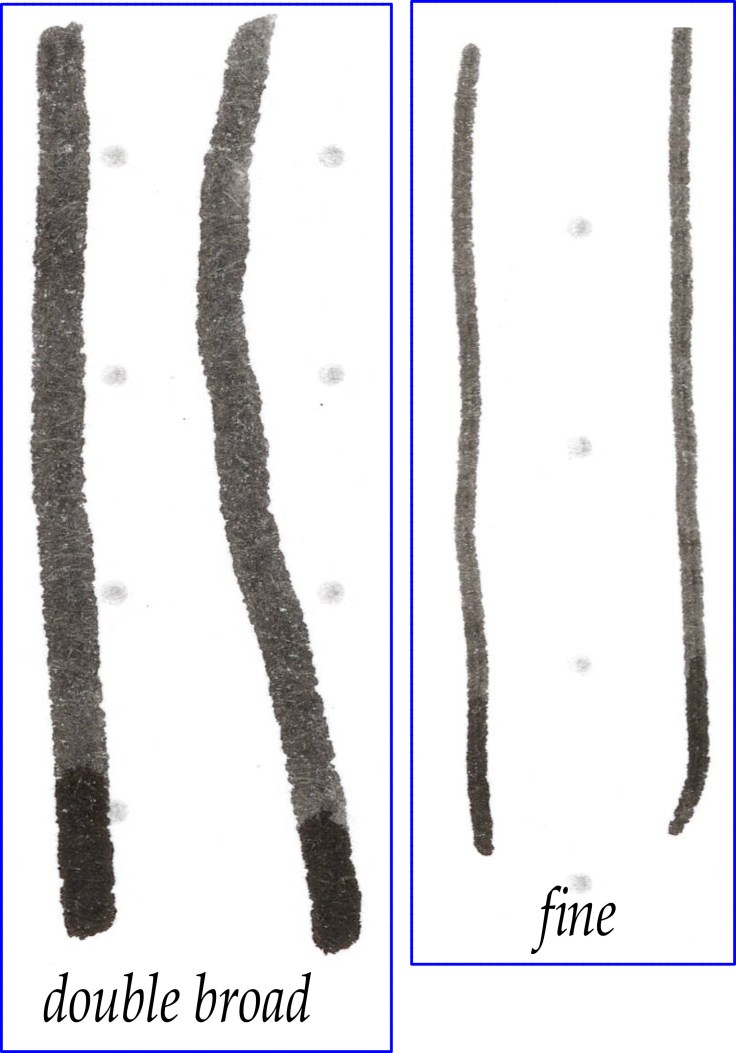
Shading is present in all inks to some extent. Which shading looks the most appealing is more a matter of personal taste. The Cross and J. Herbin inks exhibit relatively intense shading.
Bleed-Through
Pelikan 4001, Cross Black, and Montblanc Mystery Black show the least bleed-through on the used paper: Rhodia White Dot Pad 90g/m2. However, the older version of Montblanc ink bleeds through significantly – well, it doesn’t seem to be sold anymore. Cleo Black and J. Herbin ink seem to bleed slightly.
Color Cast (or Hue) from paper chromatography experiments
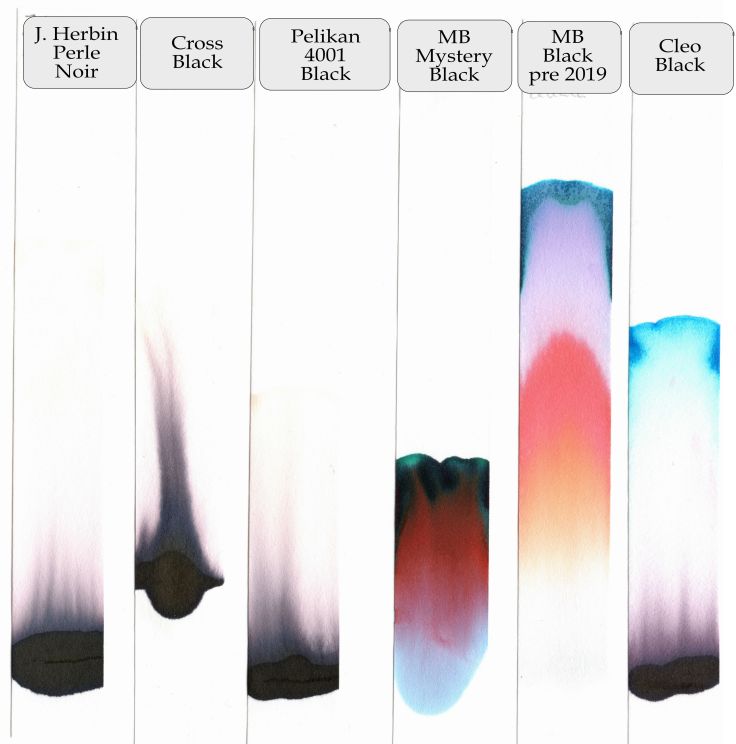
Upon examining the inks in the ink bottle (against a light background) or as a blob or smudge on paper, it becomes clear upon close inspection that all the black inks presented here aren’t actually pure black but often exhibit a slight hint of brown or blue. This prompted me to perform paper chromatography with the inks. And behold, during the experiment, three inks separated into very colorful components. Particularly striking is the “Montblanc Black” from before 2019 (see chromatogram). This ink contains no trace of black pigments, as four colors separated (blue, pink, red, and orange). Its successor, “Mystery Black,” consists of three separating colors: blue, red, and black-green. The inks from J. Herbin Perle Noire, Cross Black, and Pelikan 4001 Black are very similar and show no clear color separation in the chromatogram. Their color tends toward brownish, while the Montblanc inks lean toward blue-black, and the Cleo ink, with its turquoise component, tends toward greenish.
As mentioned earlier, these subtle shades are noticeable only when you have large areas of color (and preferably smudge them). They are less apparent when writing normal words. In this review, I further enhanced the color differences by adjusting the saturation slider of the image editor on the scanned images to make the differences qualitatively visible.
Now follows the list of inks:
J. Herbin Perle Noire

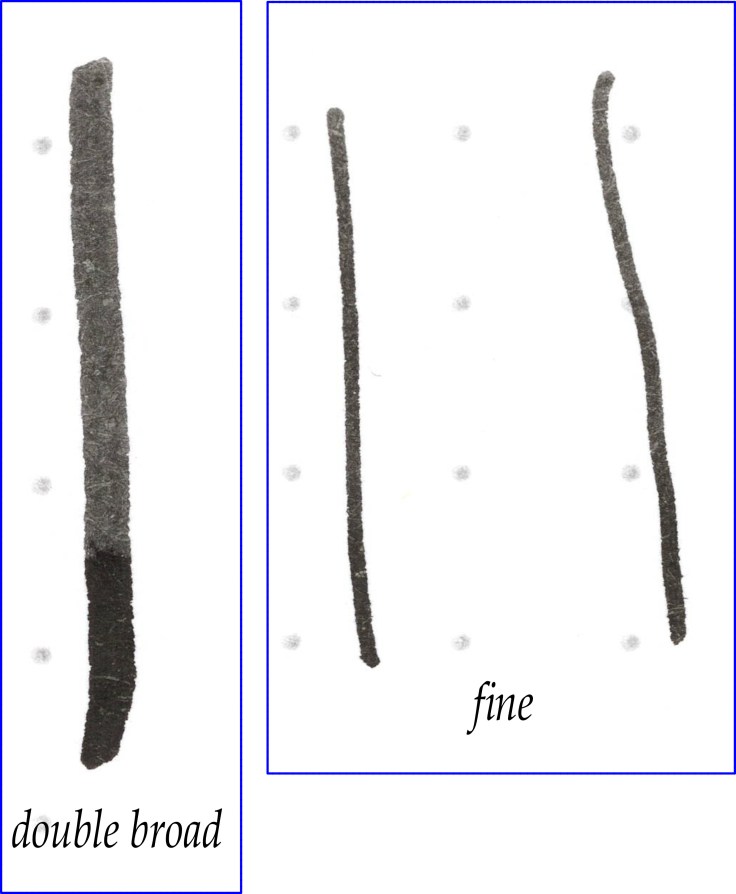
Montblanc Black (from 2019) and Mystery Black (2020)
MB Black (pre 2020):
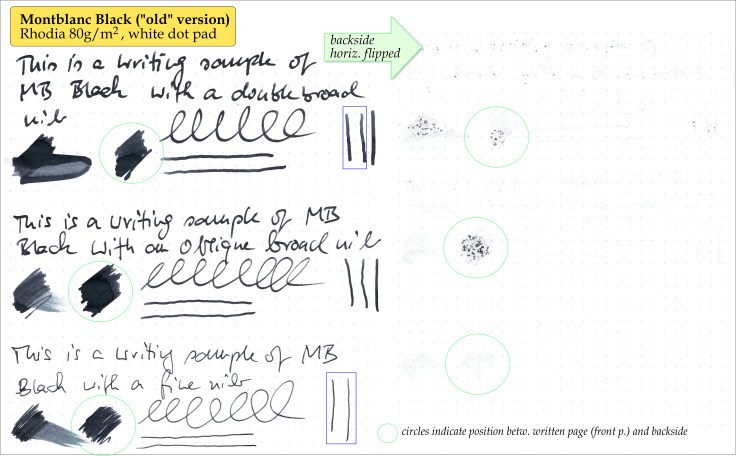
Montblanc Black (pre 2020): overall behavior. The broader the nib (and therefore the more ink is placed on the paper), the stronger the show-through and bleed through. The bleed is quite substantial. The good thing is, the ink was replaced by the Mystery Black (see below), which is much better in this respect.
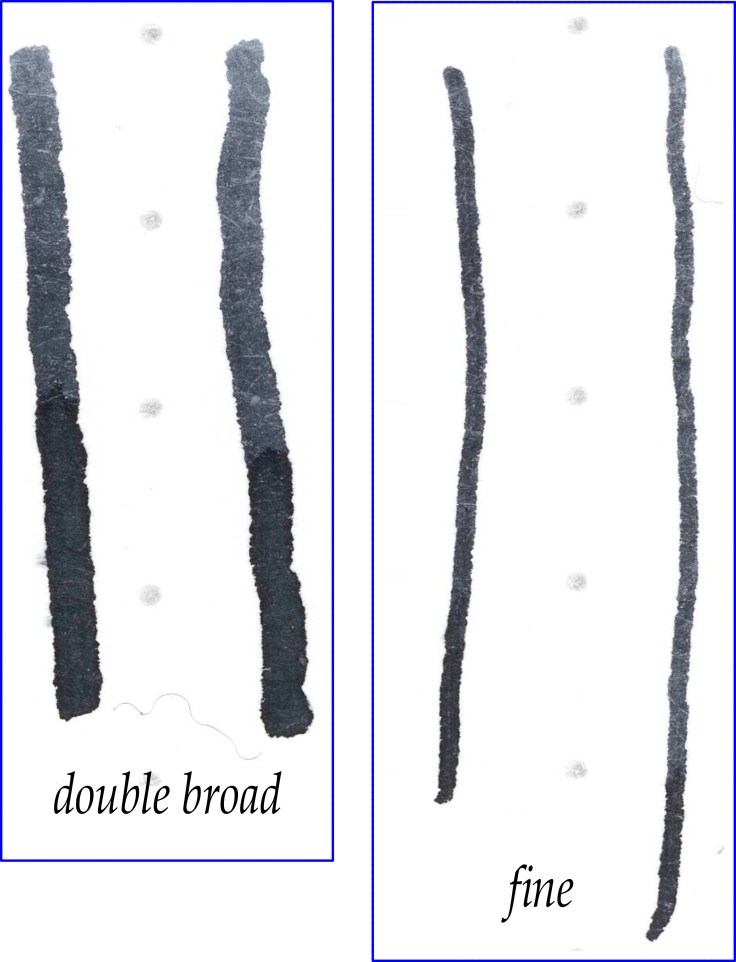
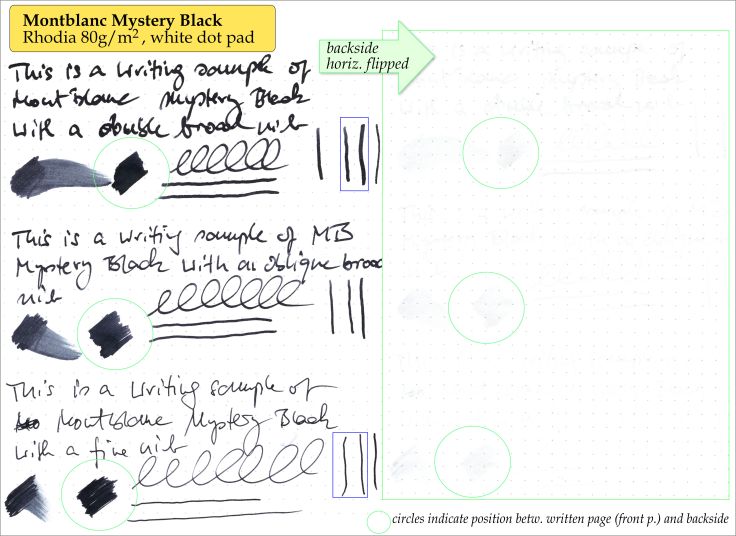
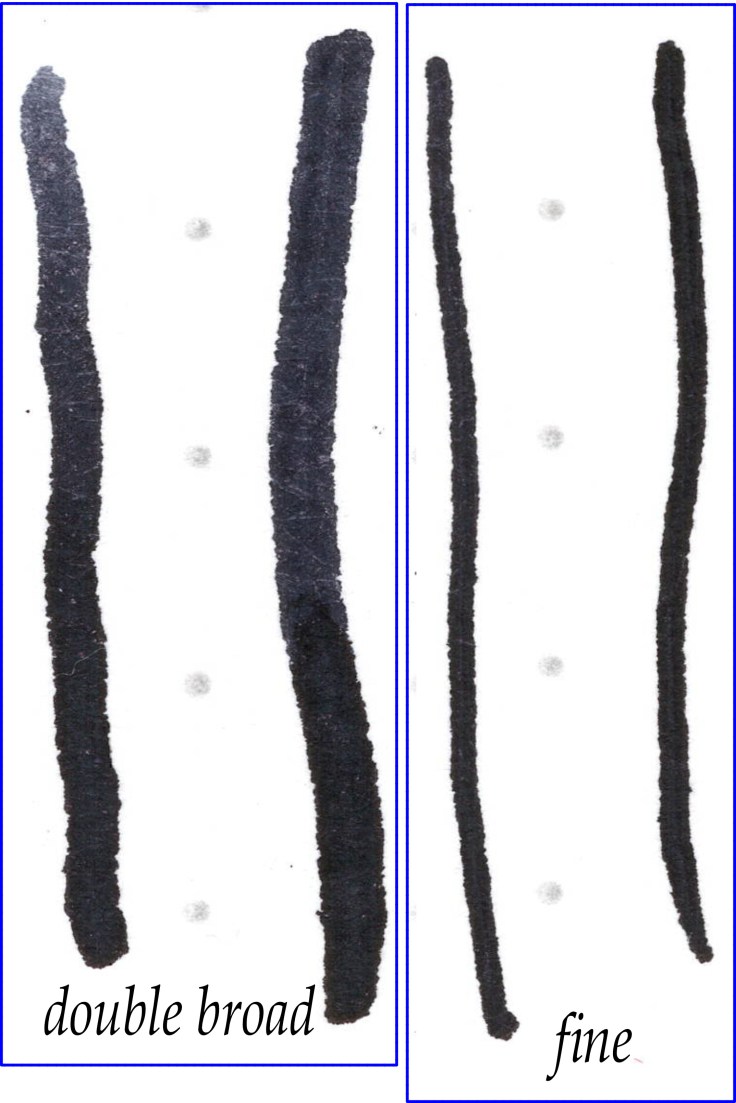
Shading of the MB Mystery Black
Pelikan 4001 Black
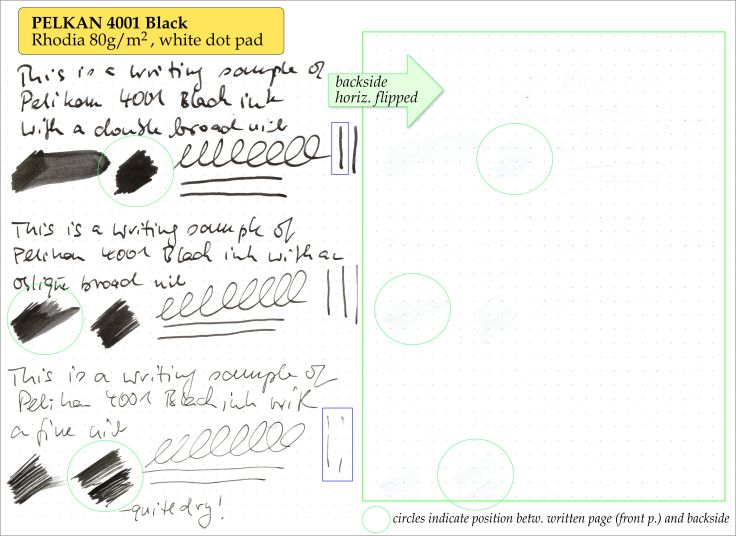

Pelikan 4001 Brilliant Black: There is actually a visible shading. The ink is quite dry so you better use a wet nib (in particular if the nib is fine).
Cleo Black


Cleo Black shows a quite significant shading.
Cross Black

Paper Chromatography
Here are shown the chromatograms of the reviewed black inks. All relevant information is given in section “Color Cast (or Hue) from paper chromatography experiments” above. The pictures speak for their selfs


 Nibbinibnibb
I am a huge fan of the J. Herbin Perle Noir and it’s the only black ink that I now use. I dedicated my LAMY 2000 to it.
LikeLiked by 1 person