
This question I cannot answer, but I may can say which pen (or at least pen type) is more prone to dry out faster than another pen type. And I talk here about fountain pens only.
It sometimes happens that you don’t use fountain pens for a long time or you replace cartridges before they are emptied and think you can use the remaining ink again later (at least you think so, but you rarely do it, and if you do, you should do it quickly, as the test shows). My curiosity was piqued again and I thought it could be fun to measure how quickly ink in fountain pens (or cartridges and converters lying around) dries out.
I have tried to include the most common (both: known to me and available for me) brands. The 28 pens, individual converters, and single cartridges used can be grouped as follows:
(a) Piston Fillers
(b) Cartridge/Converter Pens (inserted into the resp. pen)
(c) Converters (non-inserted into a pen)
(d) Cartridges (non-inserted into a pen)
Among converters and cartridges, the “Standard International (SI)” ones can be distinguished from those for the Lamy System, Cross, Platinum, and Sailor. Among pens (both piston fillers and cartridge/converter pens), those with screw caps and snap caps can be differentiated. Typical snap caps include Lamy Safari, Cross Wanderlust, Graf von Faber-Castell (Short GvFC) Guilloche, Lamy 2000, Montblanc 144, and Parker 25. Almost all piston fillers, except the mentioned Lamy 2000, have screw caps. Additionally, Sailor, Platinum 3776, and Kaweco Sport have screw caps.
So, what needs to be examined?
- Whether presumably less tightly sealing snap caps dry out faster than screw caps. Quick result: they do by far!
- How quickly converters and cartridges dry out or ink evaporates if not inserted. Quick result: they evaporate quite quickly (no suprise).
- How much faster cartridge/converter pens dry out compared to piston fillers.
- Whether standard international cartridges and converters (SI) with their smaller openings dry out more slowly than the non-SI equivalents available to me from Lamy, Pilot/Platinum/Sailor, with their larger openings.
Procedure:
(1) Cleaning of the pen, converter, cartridge
(2) Drying of the pen, converter, cartridge.
(3) Weighing the cleaned, dry pen, converter, cartridge → Empty weight or base weight.
(4) Filling the pens, converters, and cartridges. Converters and cartridges filled with a syringe for about 0.4-0.7 ml. Piston fillers are filled with 0.4 to 1.3 ml sing the built-in piston system (quantity poorly estimated). The ink used was consistently Pelikan 4001 brilliant ink Turquoise.
(5) Weighing the filled pens, converters, and cartridges.
(6) Leaving the pens, converters, and cartridges on the desk. Pens stored horizontally, cartridges and converters stored upright. All writing instruments, cartridges, and converters were exposed to the same room conditions throughout the study, which naturally varied with the weather/room temperature – just like in a real office/living room. The test was conducted in summer; the heating was never turned on.
Certainly, a “real” scientific test would have required constant temperature (and humidity), which I do not have the means to maintain. Therefore, the results may vary for different seasons and living conditions (but in real life, nobody has a constant 20 degrees and, let’s say, 70% humidity in their living spaces either).
(7) Occasional weighing, writing sample to check ink flow or pen drying. The pens were always weighed without caps since I observed condensation forming inside the cap of demonstrator pens – a situation that makes it impossible to accurately determine ink loss.
(8) Evaluation of the results after 69 days regarding the research questions.
What I did not test was leaving a pen filled with ink uncaped. This would simply lead to ink drying out and clogging the feed (this is not conductive to the study and would also be detrimental since cleaning the pen would have been intensive).
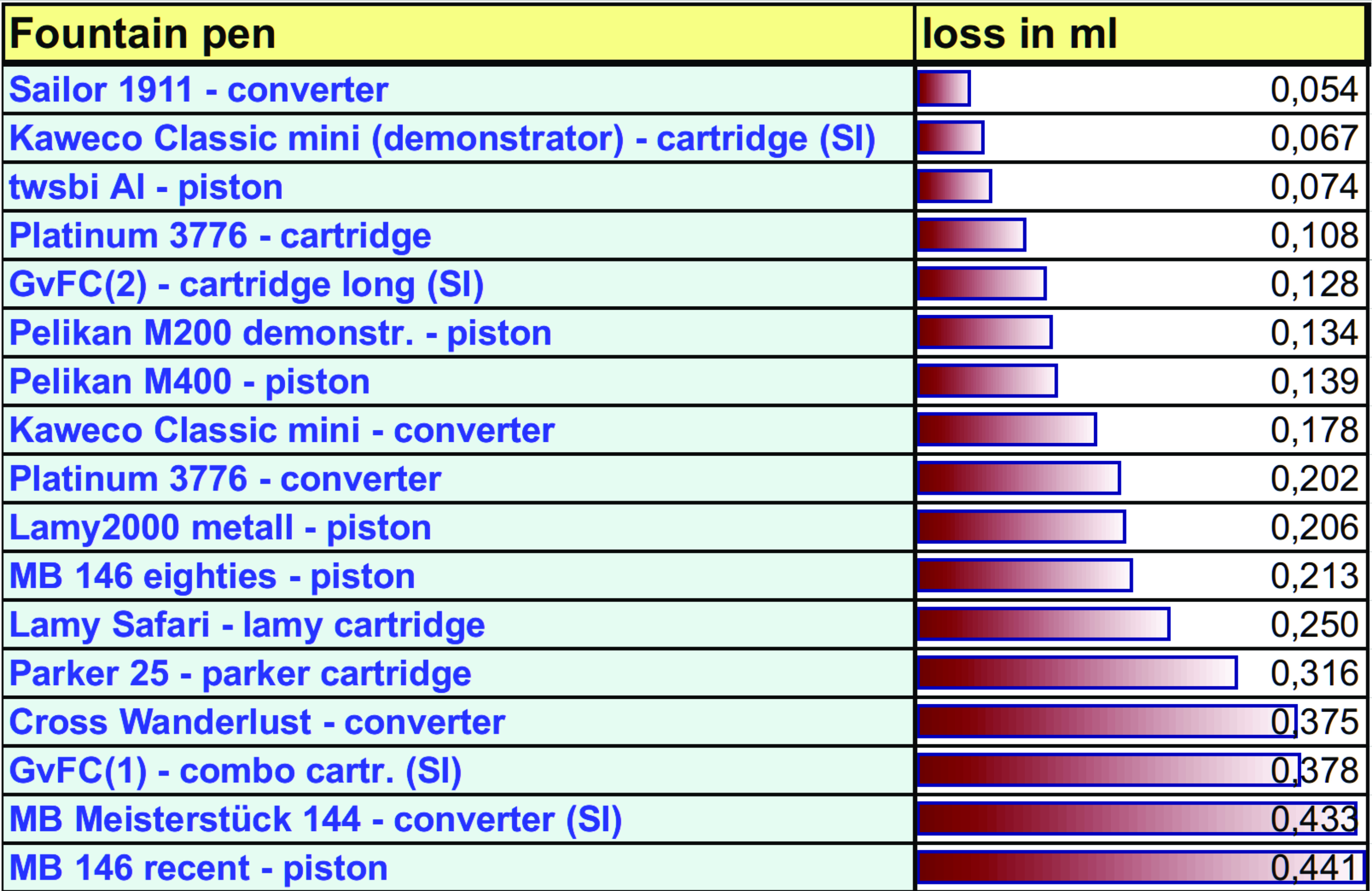
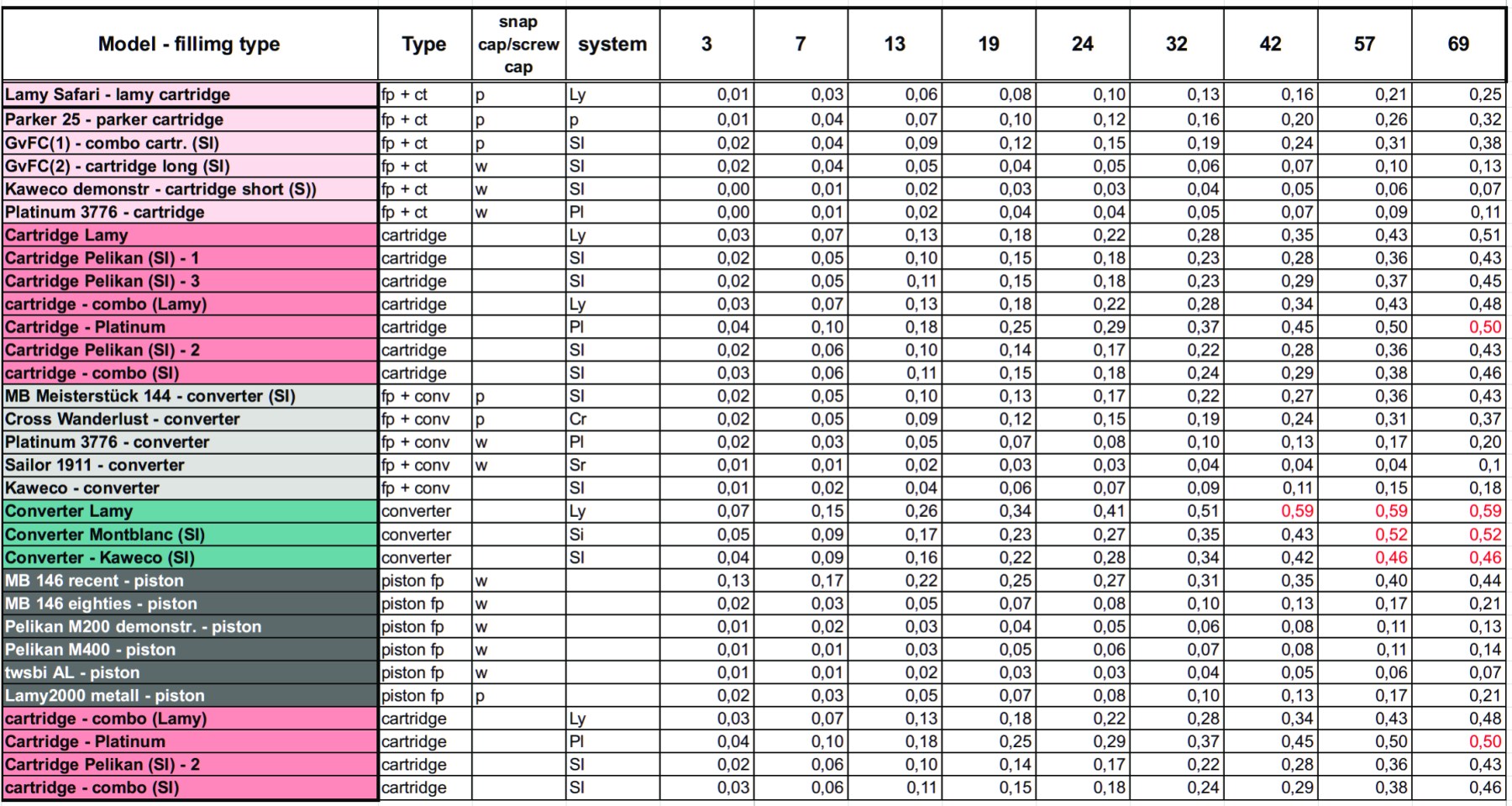
And here are the results (see fig. 1 till 10 and table 1):
(1) No pen dried out during the almost 70 days the test lasted, so none of them failed to write.
(2) From non-inserted cartridges/converters, ink escapes about 3 times faster than from those inserted into the pen. This is not a big surprise, but depending on the cartridge/converter’s fill level (the latter holds about 0.8ml of ink), it’s over for the ink after 100 days (about 3 months). Depending on the fill level or capacity of the cartridge (1.5ml is possible), a cartridge left in the pen lasts for about 300 days to well over a year (fig 1 -4).
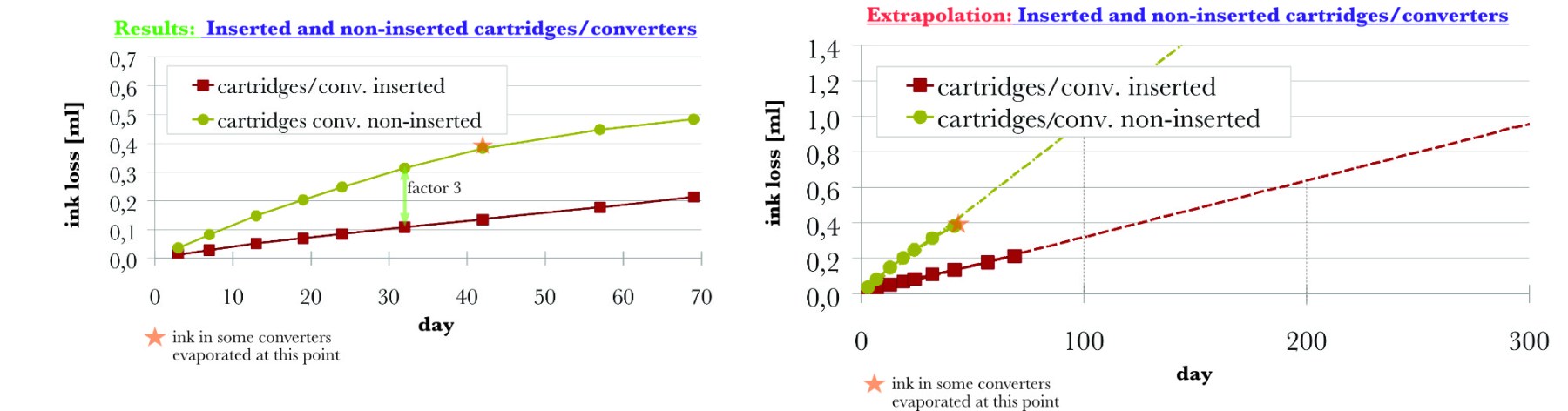

A huge deviation of factor 2 can be observed between the Lamy converter (fast drying out) and the Lamy cartridge. The Lamy converter (not inserted) dried out after day 40, the SI-converters from Kaweco and Montblanc dried out after day 57. To make that clear, the mentioned converters (and neither the cartridges) were filled completely rather than roughly just to the half.
The Standard international cart/conv are generally less prone to loose ink so quickly. They also behave quite similar in this respect.
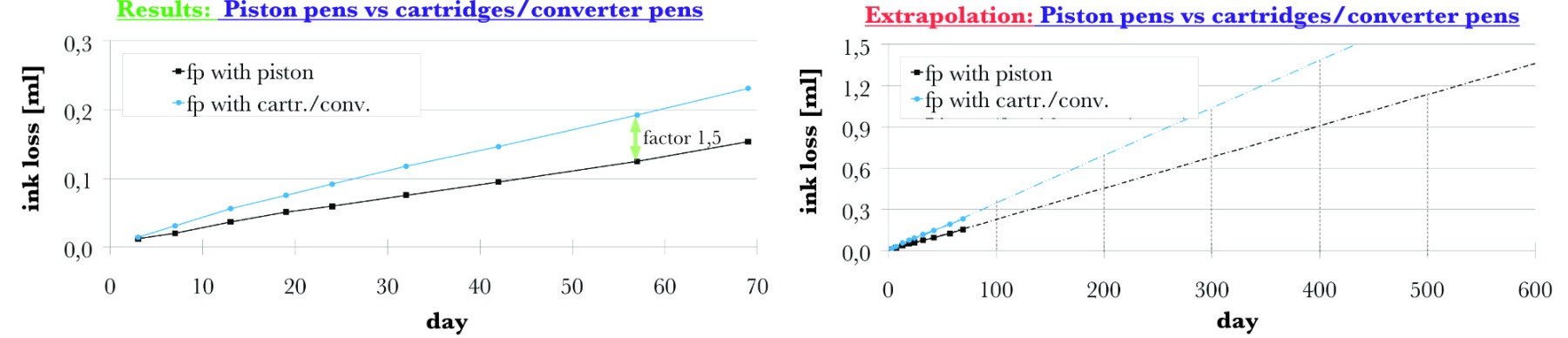
(3) In piston pens, the ink lasts about 50% longer than in cartridge/converter operated pens. However, there can be exceptions. One of the tested Montblanc 146 pens caused the ink to evaporate much faster than its counterparts (from MB, Pelikan, Lamy, and TWSBI). See fig. 6 and 7
The distribution of results among cartridge-converter pens versus piston pens is shown below in fig.5. One piston pen shows a remarkable high ink loss. It is the Montblac 90 years aniversary Meistwerstück 146. But I believe it has an issue with the sealing (since it is a real outlier and the conterpart from the eighties behaves quite well).

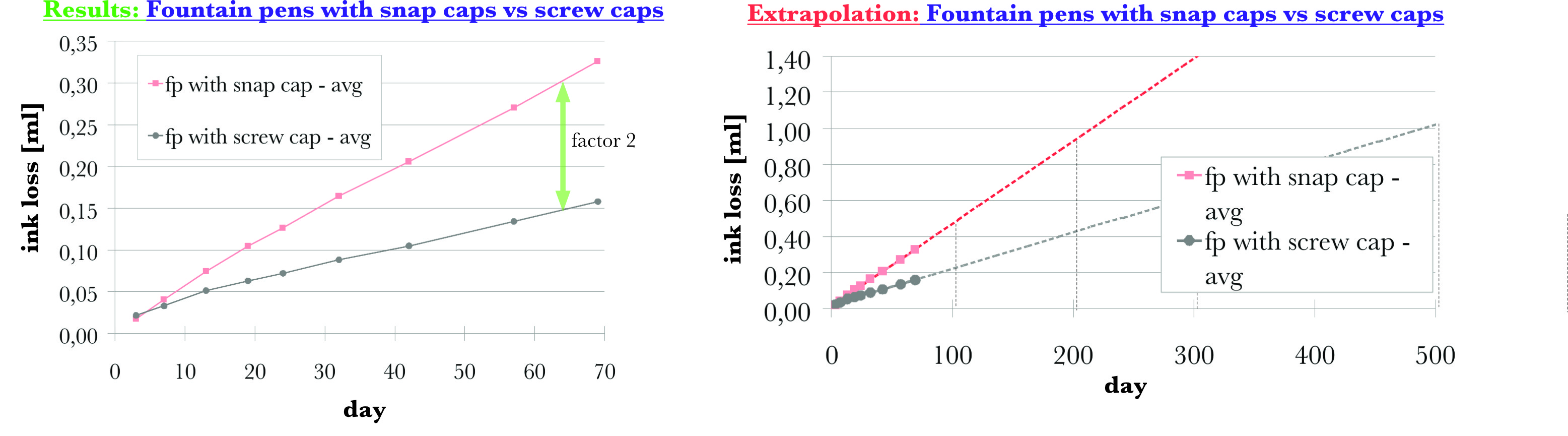
(4) Pens with screw caps hold ink approximately twice as long as pens with a snap cap (system-wide), see fig. 8 thorogh 10. It should be noted that most screw cap pens are piston pens (except the Lamy 2000). The distribution of ink losses shown in a histograms (fig.8) clearly show, that screw caps can prevent ink loss much better than pens with a snap cap, though. Examplarily, the Graf von Faber-Castell Guilloche (snap cap) loses about three times as much ink as the Anello of the same brand with a screw cap.

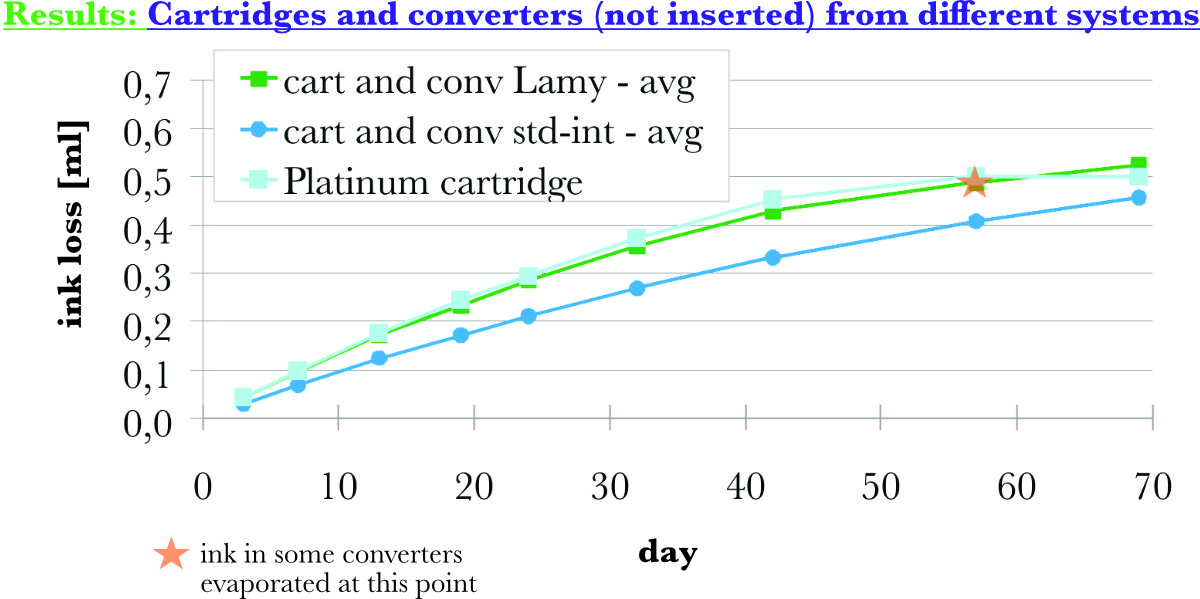
(5) Lamy and Platinum cartridges and converters lose about 20% more ink in the same period than standard international (SI) counterparts (non-inserted). The openings of Lamy and Platinum have a considerably larger diameter than SI (Pelikan, MB, GvFC, Kaweco, etc.). The results are quite consistent, so coincidence should not play a significant role here.
(6) Combo cartridges with openings at both ends (SI and Lamy) from third-party providers show no significant deviation from their original brand counterparts (figure not shown).
(7) Finally, a few individual results:
Surprisingly, ink evaporates the slowest from a cartridge pen (equipped with a short SI-cartridge). It’s the Sailor 1911 (with a proprietary converter). Right after that follws another cartridge/converter pen, the Kaweco Classic mini (demonstrator). What favors this result might be the fact that it has a screw cap. Then follows the TWSBI Al, a piston pen with a screw cap, and the Platinum 3776 with a cartridge (also screw cap).
A bit unusual is the evaporation pattern in the GvFC Anello; here, it seems it temporarily gains ink (the loss decreases instead of increasing – see table 2, day 19). I think, for some reason, this pen, which has a wooden barrel, absorbed a bit of moisture (sweaty fingers?), which was released over time.
An outlier in terms of ink loss was observed with the Montblanc Meisterstück 146 (90 Years Meisterstück aniversary), as you know a piston pen. It loses by far the most ink over time. I suspect an anomaly here (an issue with the sealing). Another (though older) model performs better in this respect.


 Nibbinibnibb
I knew I wasnt crazy… I have a beautiful light blue ink turquoise ink (konpekki) that turns into just blue as it gets more concentrated. Looking at my notebook it was beautifully turquoise when it was just inked up and it was slowly turning bleh bleu and I thought perhaps there was contamination in the brand new pen or perhaps the nib was rusting or something.
It was a GVFC with a snap cap
LikeLike